
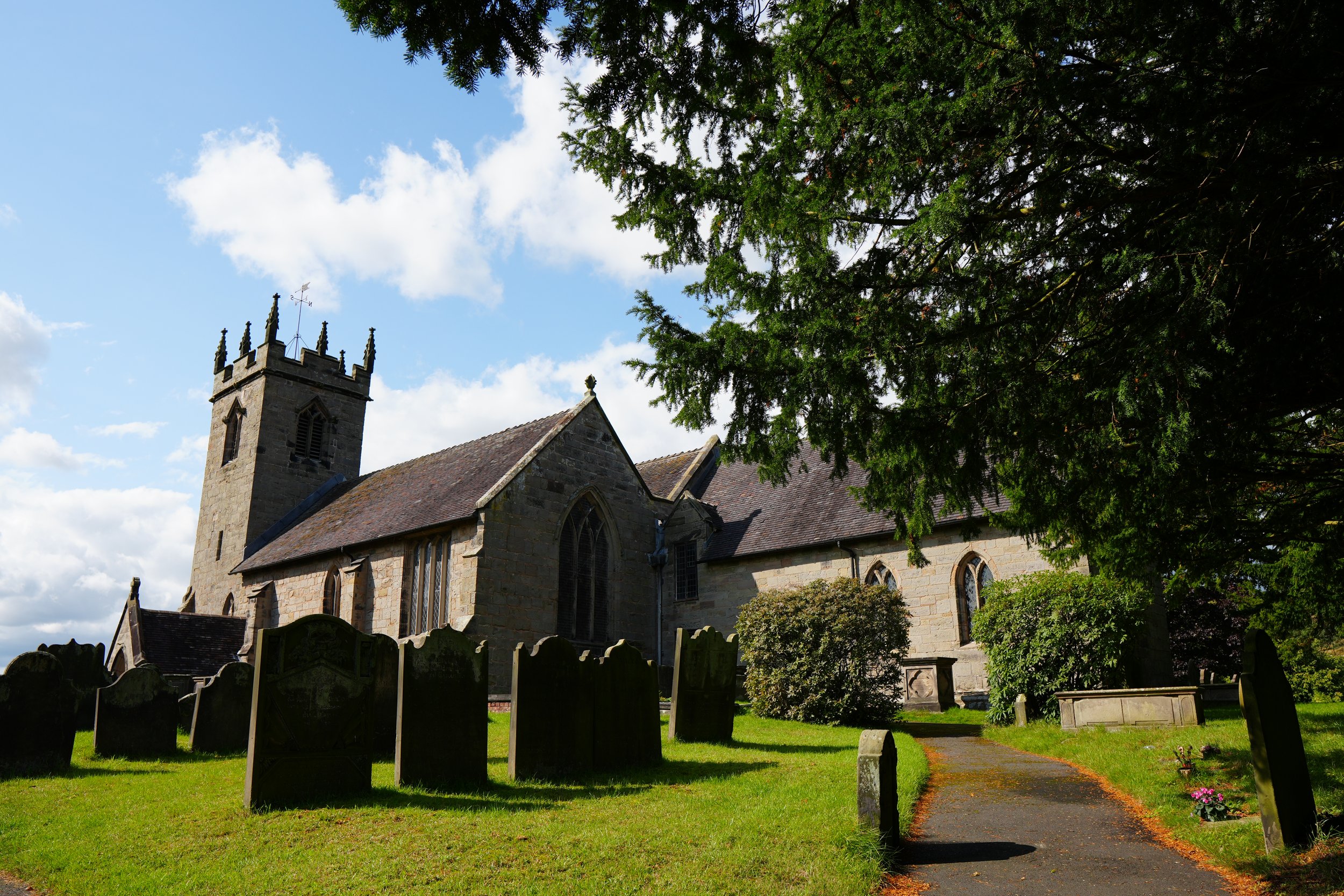
Six Special Features at Sandon All Saints
Sandon All Saints is not just a place of worship; it provides a historical record of the social and political history of Staffordshire, England and Great Britain. It is hard to imagine in a more secular age just what a powerful influence the Church exerted over people’s everyday lives over the centuries, or how the church itself has had to adapt to the political forces exerted on it as religion and politics inevitably intertwined.
Within the chancel is preserved a very rare genealogical suite of post-Reformation art works, being the main reason for the building being Listed Grade 1.
These features together with other historical artefacts in the church, evidence the cultural and sociological changes, and in some cases survived only because they were hidden for centuries after falling out of favour. At every stage it is the craftsman who delivered, and they have left their mark behind in the monuments, the windows and on the walls and remain as a living testament to many skills that are now lost or rare. We hope you enjoy this deeper look at six of the special features in the church, four of which had conservation work carried out on them in the National Lottery Heritage Fund project in 2025/26, “Making available the Heritage of All Saints Sandon, whilst securing its future heritage”.


The Wall Paintings
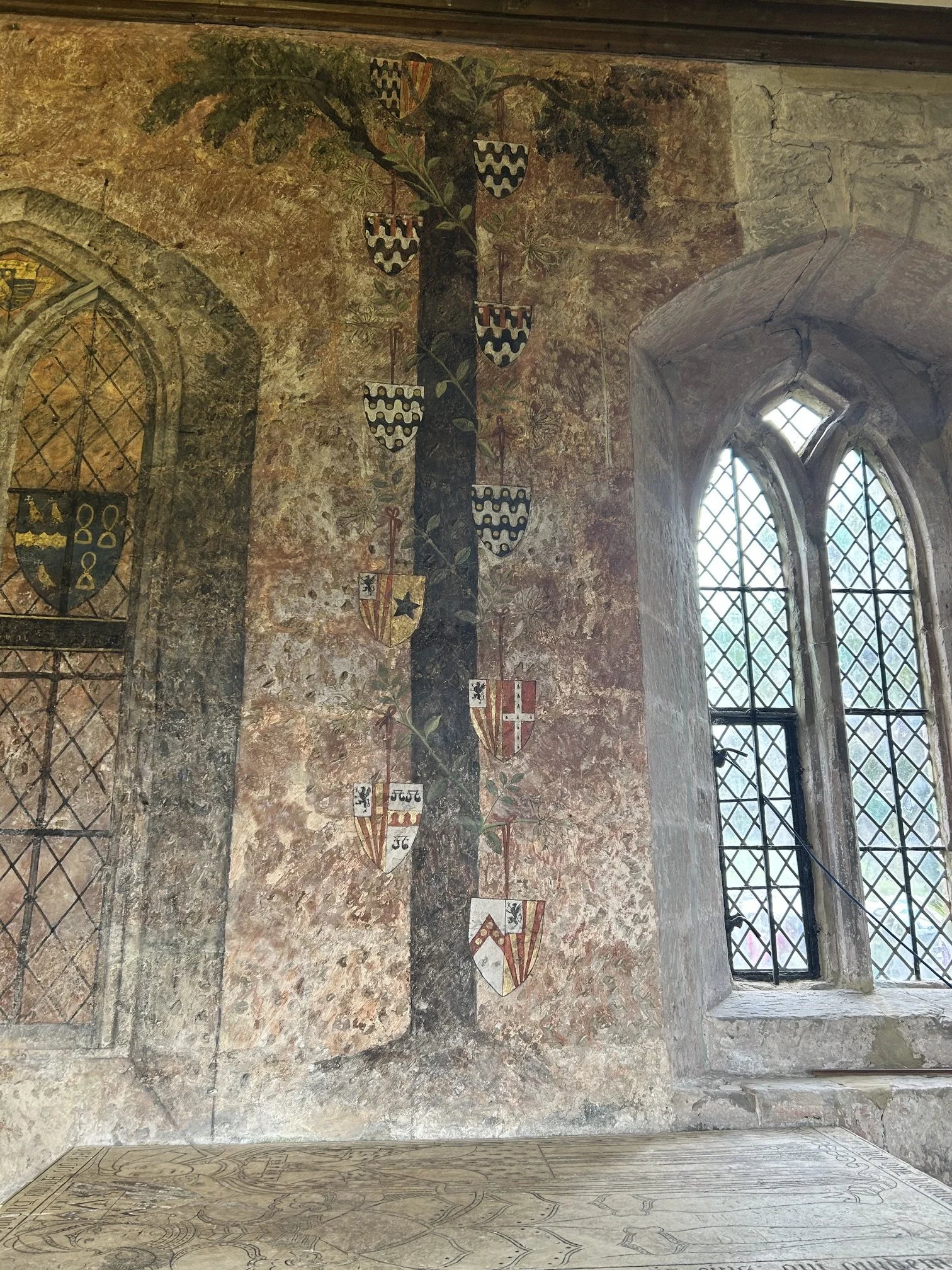
Evidence of the desire of Sampson Erdeswicke ( 1535 to 1603) Lord of the Sandon Estates, to celebrate his family is shown by the wall paintings in the chancel, which are a rare survival of post-reformation painting.
Dated from 1599 to 1603, the wall paintings depict four genealogical trees displaying thirty-eight shields bearing the coat of arms for the families connected with the Erdeswickes, on the distaff (male) side, each issuing from one of the four family tombs lining the east end of the chancel. Each tree represents one of the families of Basset, Harcourt, Grey and Leigh, back to Edmund Ironside and Emperor Conrad.
On the north wall, with its one window, a second faux window has been painted to provide balance with the two windows on the south side.
Part of the paintings on the south wall were lost during the creation of a new gallery pew for the Harrowby family in 1782, when part of the south wall of the chancel collapsed. The remaining paintings spent many years hidden under plaster. They were uncovered as part of the major restoration of the church in 1929, although the keying marks made by the plasterers can still be seen.
The Sandon painting, both in its scale and in its conceptual and technical complexity, may well be the most ambitious scheme of its type surviving in England. (Shekede & Rickerby)
The conservation of the wall paintings was an important part of the National Lottery Heritage Fund project carried out in 2025/26, to remove the accumulated dirt and the wax covering from 1929. Colours, texts and designs are now visible which haven’t been seen for a century.
The Erdeswicke Monuments
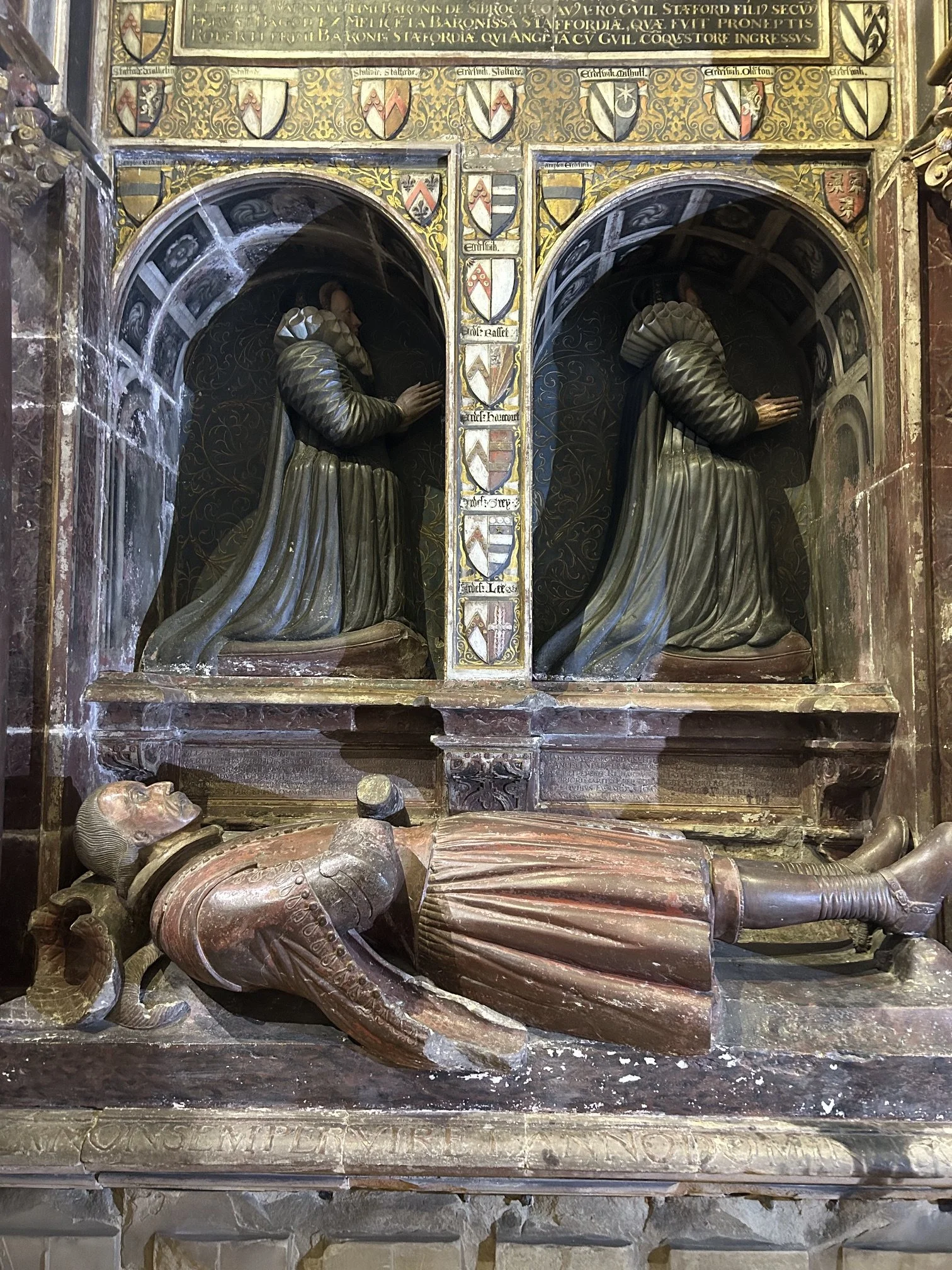
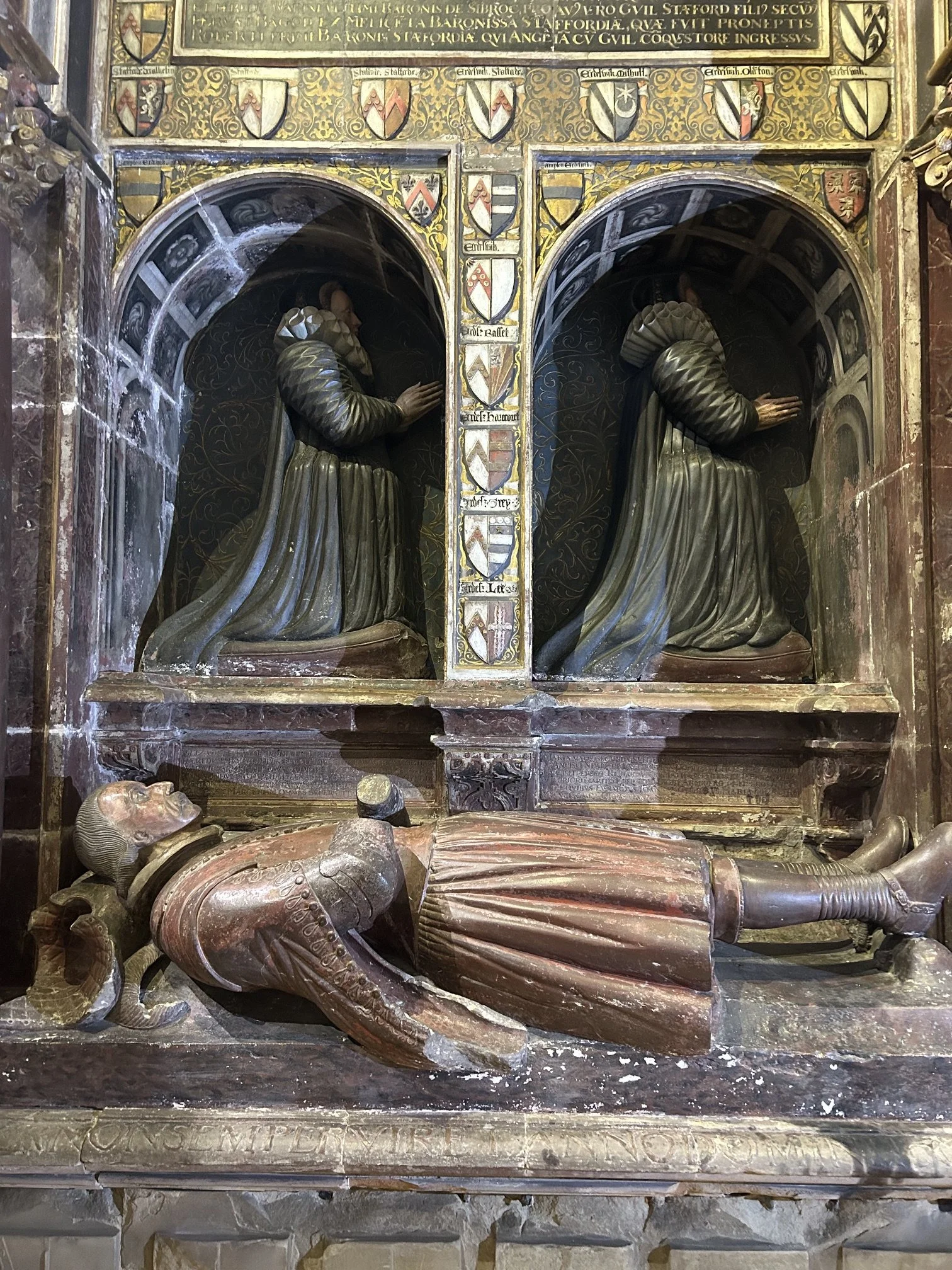
Located in the chancel, the genealogical suite continues in the imposing floor-to-ceiling monument to Samson Erdeswicke, which he erected two years before he died in 1603. His reclining figure dominates the tomb and above him, surrounded by the coats of arms of their family connections, kneel his two wives, Elizabeth and Maria.
As a direct descendant in the male line from Richard de Vernon, Baron of Shipbrook, he placed the punning motto of the Vernon family below his effigy, ‘Vernon semper viret’. If the first word is taken as two words it means ‘The spring does not always flourish’, and if read as one word it becomes ‘Vernon flourishes always’.
His reclining efergy has its hands missing which would most likely have been placed together in prayer. It is not known how this happened. Oral history has it that Parliamentary troops, who were likely billeted in the church before the nearby Civil War battle at Hopton Heath in 1643, chopped off his hands, (as it was only 40 years after his death and he would have been considered a Royalist). Alternatively, It might have happened when the roof and ceiling collapsed in 1782 during the building of the first balcony.
Other pieces of the monument are missing, some found during the 2025/26 restoration. under the National Lottery Heritage Fund project, which removed accumulated dirt and wax covering from 1929.
Further information about the nearby family tombs and stained glass can be found in the History By Era section.
Royal Coat of Arms
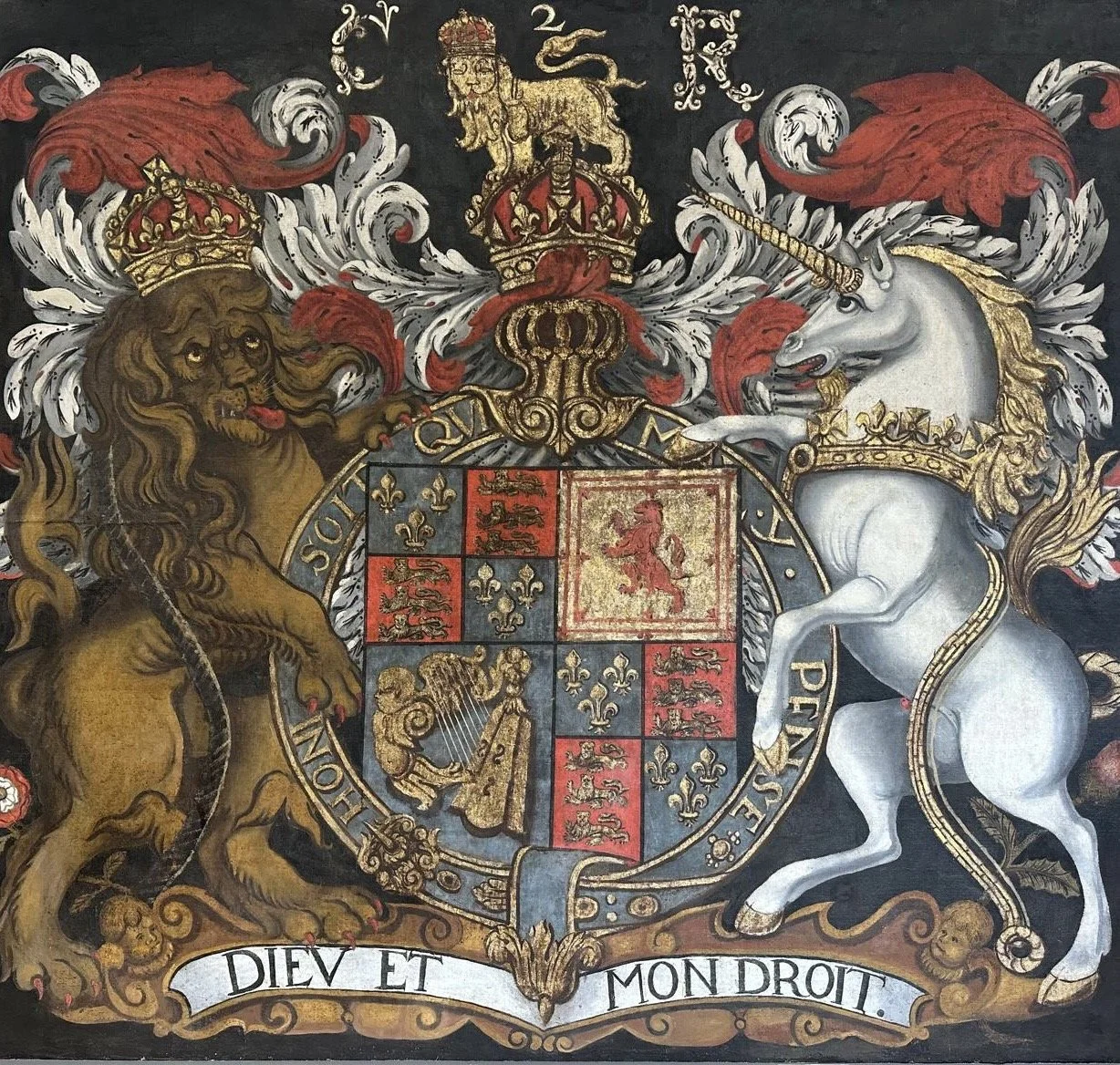
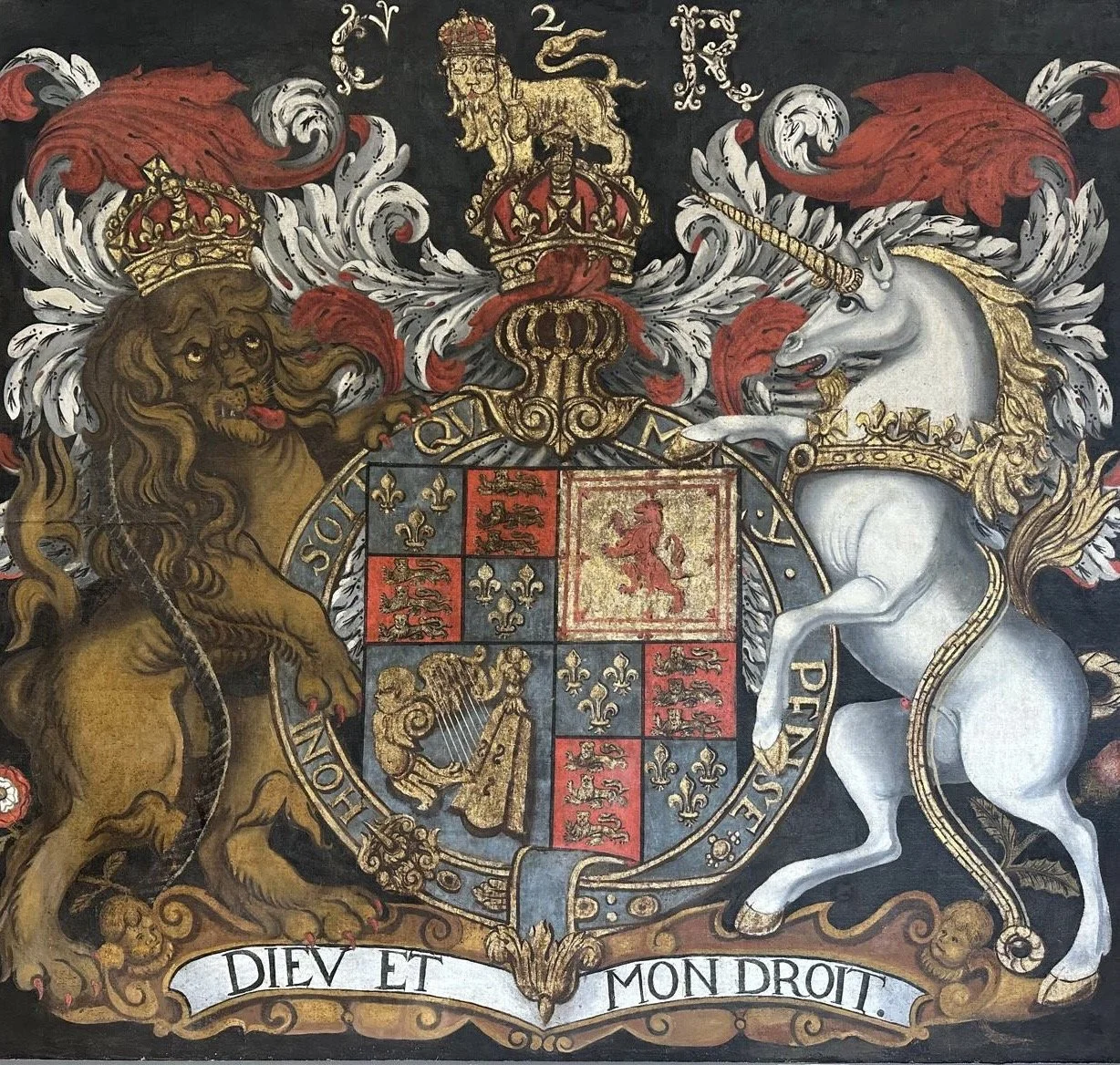
Hanging on the north wall of the Nave, the Royal Coat of Arms is an imposing painting, made to show the allegiance of the Lord of the Manor, to the Stuart monarch of the day, but which one, Charles I (reigning from 1645 to his execution in 1649 or more likely to Charles II reigning from 1660 to 1685). Before 2025 the painting and figures were hardly visible and it was clearly not central in its frame, resulting in part of the lion’s bottom on the left-hand side being missing. What had happened when it was framed? Had the artist painted on a canvas that was too large or had the frame already been made and too small for the canvas?
This mystery was resolved when the Royal Coat of Arms was taken away for conservation and taken out of its frame, under the National Lottery Heritage Fund project in 2025/26. This revealed “C2 R” ie Charles II (1660 – 1685). It also revealed the canvas on the left-hand side folded around the edge, to complete the painting of the lion. The top was also folded over. So, the frame has had to be extended to what you see now.
Jacobean Pulpit and Tester
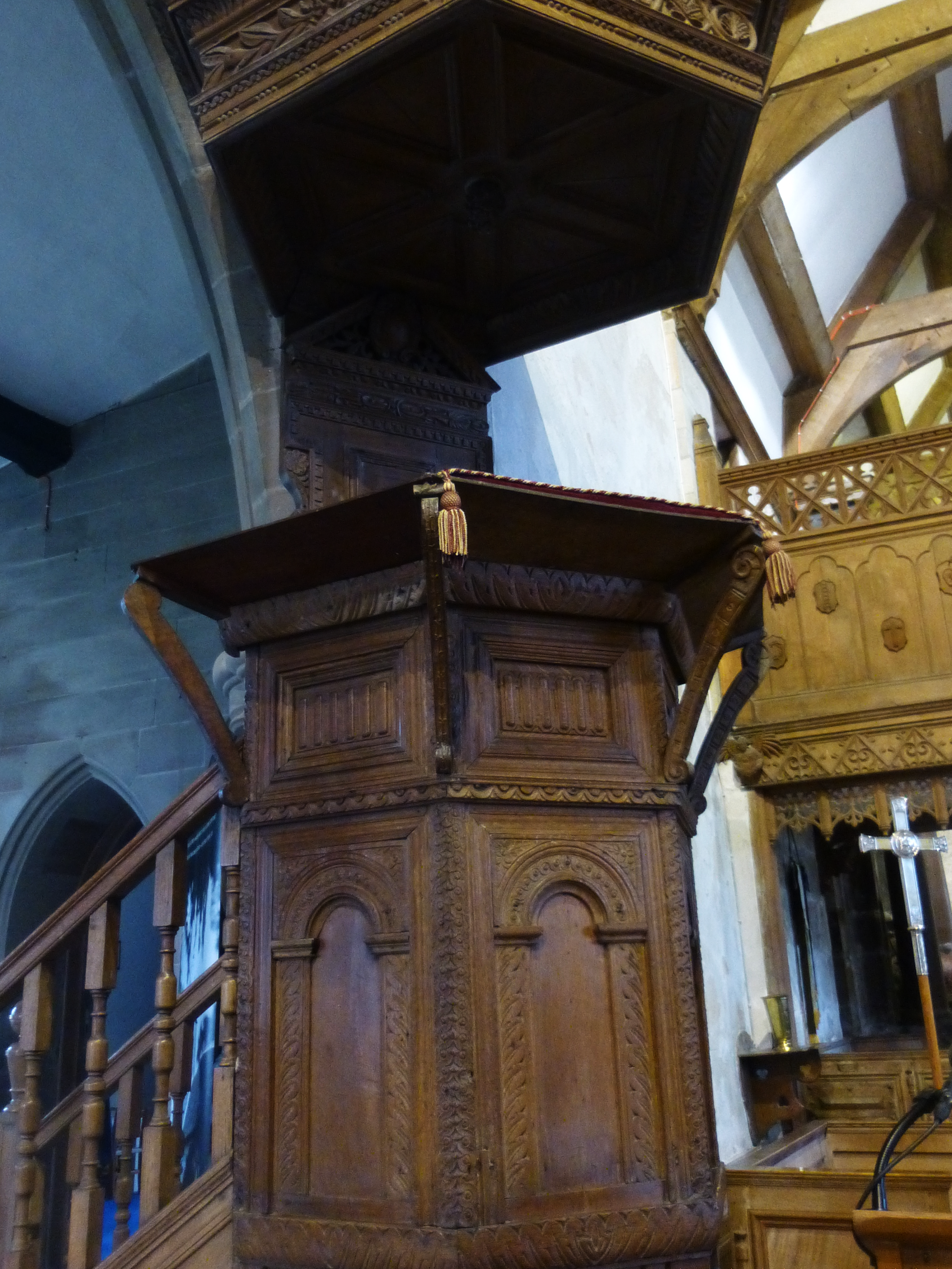
The beautiful Jacobean pulpit and tester were provided by George Digby in 1655, as part of a series of alterations. A tester, the canopy over the pulpit, was often included to provide an acoustic effect to aid in sound projection.
The All Saints pulpit sits on a base that appears to be of a different standard of woodwork, as does the staircase to the pulpit, suggesting that it was probably later than the carving of the pulpit. As the rear of the pulpit does not sit easily against the stone column it seems likely that the pulpit was imported into the church from elsewhere in 1655. It is known that the pulpit, which appears to have been made to stand on the floor, had a new oak staircase provided for it in 1918.
Hatchments
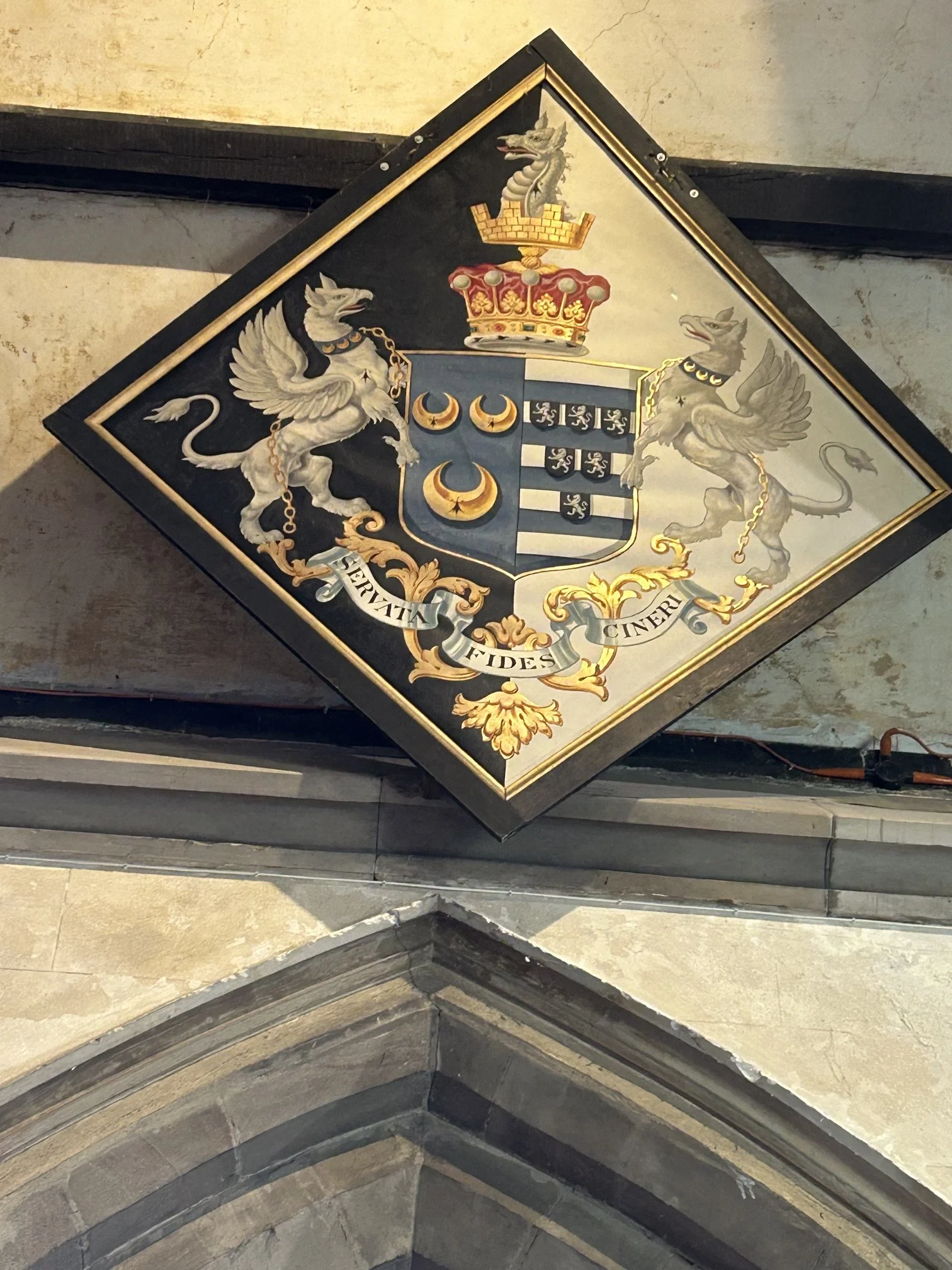
The 7 hatchments high up on the ceiling of the Nave, note the death of an Earl or Countess of Harrowby, family name Ryder. They are painted on a lozenge shaped board and the way they are painted shows whether it relates to a male or female. It is unusual to have so many.
A hatchment was made following the death of the Earl or Countess and fixed to the front of Sandon Hall to show that the family was in mourning.
On the south side of the ceiling the hatchments relate to;-·
Susan, 1st Countess of Harrowby, d 1838
· Dudley, 1st Earl of Harrowby, d. December 1847
· Dudley Francis Stuart 3rd Earl of Harrowby, d. March 1900
· Henry Dudley, 4th Earl of Harrowby, d. December 1900
On the north side of the ceiling the hatchments relate to;-
· Nathaniel, 1st Baron Harrowby, d. June 1803
· Dudley, 2nd Earl of Harrowby, d. November 1882
· Frances, 2nd Countess of Harrowby, d. March 1859

The Stained-Glass Windows
While the oldest glass in the church is just a fragment of an early 14th-century pinnacle set in the tracery light of the baptistry west window, some of the most beautiful examples can be found in the stained-glass windows.
The east window with clear and cathedral tinted glass shows the arms of the families who have owned Sandon land in the distant past. (See History By Era)
The most striking stained glass is in the west window of the nave and in the window in the Lady Chapel,
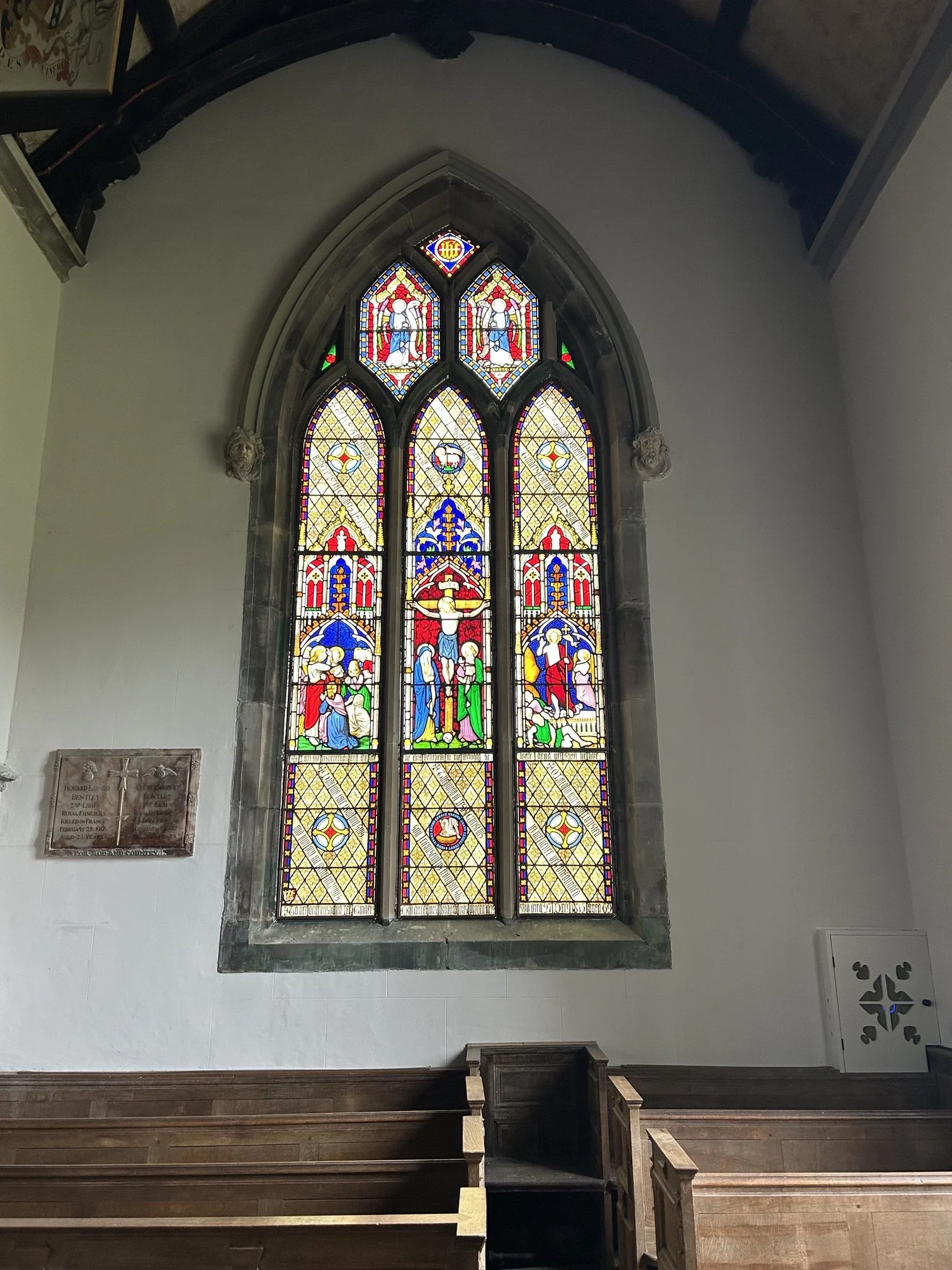
On the west window is a lovely example of stained glass by William Wailes, 1846, in the style of architect Augustus Pugin. The main lights, from the left, depict the raising of Lazarus, the Crucifixion and the Resurrection. The makers mark is in the extreme bottom left, while the whole is interspersed with quotes from the Bible. The window is dedicated, by his widow Margaret, to the memory of Jeremiah Ginders who died in December 1845 His life is well documented.
There is the possibility that the middle sections of the 3 main lights were reconditioned in 1927 with a quoted cost of £28-15 shillings, excluding any time for a stonemason, but on a day when the bus service was running so that the workmen could get to Stafford with the glass
Of a similar style is the stained glass in the Lady Chapel, dated 1856, provided for by a younger son of Walter Charles Hopper in memory of his father. .
The West window, (now “double glazed”) and the Lady Chapel window were conserved under the National Lottery Heritage Fund project in 2025/26. See History by Era for more details
More details can be found of this interesting family connection to All Saints in the History by Era section of this website.
Make a donation

Your generosity has the power to breathe new life into the ancient stones that have borne witness to centuries of history, faith, and community. By donating to All Saints, you become a vital part of the effort to safeguard and celebrate the architectural and spiritual treasures that define our cherished landmark. A charge of 0.065% is taken from your donation by the web payment service we use. This means for each donation of £10 we receive £9.35. No further deductions are applied and the donation goes towards running and maintaining the church.